Schengen Visa from Dubai on a Filipino Passport 2026: Apply from the UAE, Not Manila
A Filipino passport holder living in the UAE applies for a Schengen visa through the consulate covering their emirate — Dubai or Abu Dhabi — on the Emirates ID, not through Manila, once the UAE residence visa is valid at least three months past the return date (EU Visa Code competence rule, checked 21 July 2026). Most pages ranking for this search answer a different question. They walk Filipinos through applying in the Philippines. A kabayan working in the Gulf does not file that way. Four things shift on your file: where you lodge it, which Philippine departure formalities stop applying, how your PSA documents are certified, and how the consulate reads your funds. Everything below is specific to a Schengen visa from Dubai on a Filipino passport. Every figure carries its own date.
One direction note first. Applying for a UAE visa on a Philippine passport — the 25 June 2026 visa-on-arrival rule — is the opposite journey and lives on our inbound Filipino-passport page. This page is about leaving the UAE for Europe. Terms used here are defined in the glossary.
Apply from the UAE, not from Manila — the residence rule for a Filipino passport
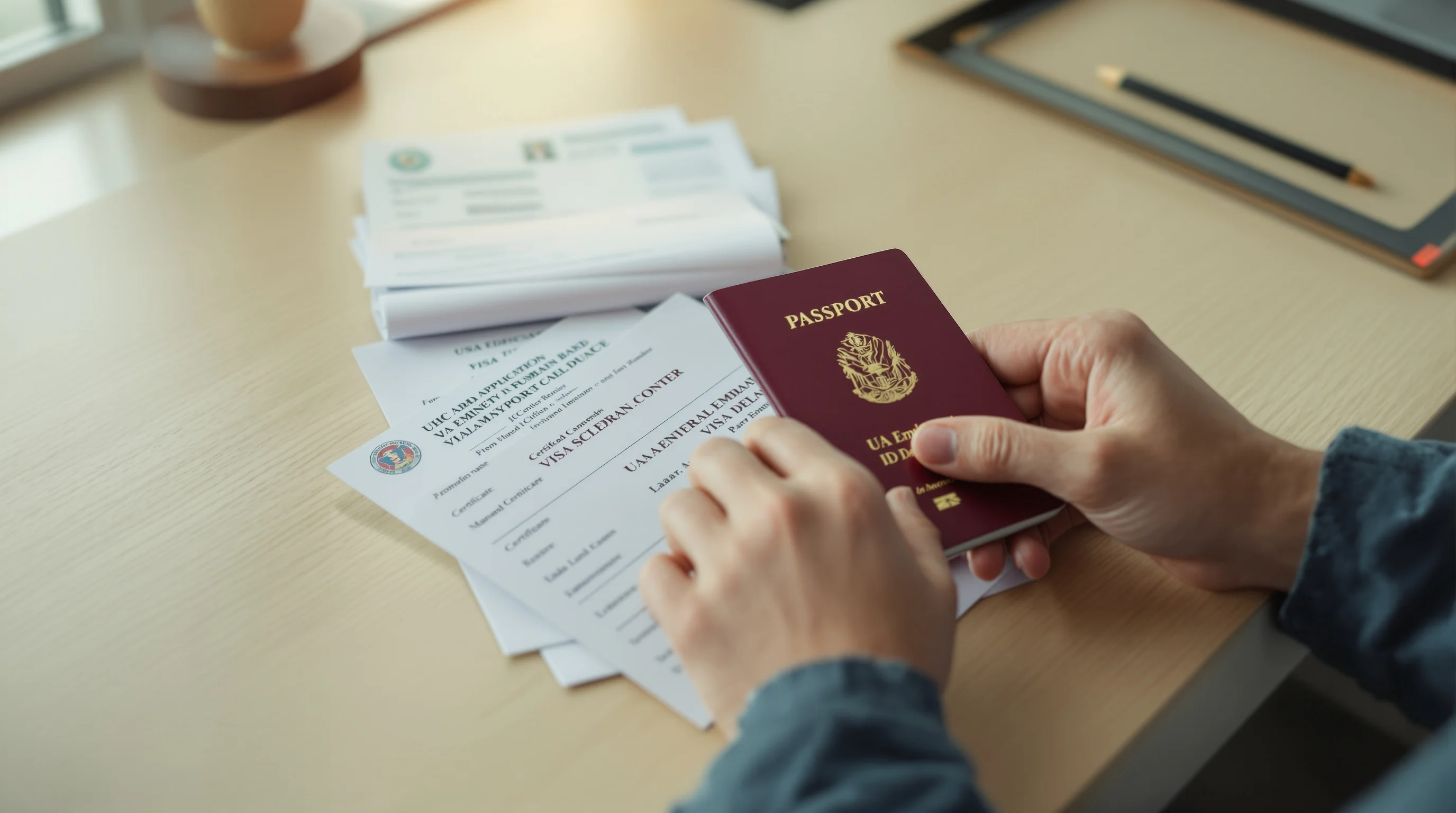
A Filipino UAE resident files at the Schengen consulate covering their emirate, in Dubai or Abu Dhabi, on the Emirates ID — not in Manila. The one hard condition is a UAE residence visa valid at least three months beyond the return date. Your passport changes what the consulate reads inside the file, not where the file goes.
The rule sits in the EU Visa Code. A consulate may examine your application only if it covers where you legally reside. For you that is the emirate on your residence visa. So consulate jurisdiction follows your Emirates ID, not the green Philippine passport. Pages that route Filipinos through DFA appointments and BM Online answer for applicants in the Philippines. Different applicant, different file.
Bring the Emirates ID as residence proof, with the residence-visa page copy beside it. If your Emirates ID falls due for renewal before you travel, renew it first — a card expiring inside the trip window undercuts the three-month rule. The scheme-level process that every UAE applicant shares lives on the Schengen-from-the-UAE overview. This page states only what the Filipino passport changes.
What does NOT follow you from the Philippines: travel tax, OEC and the departure-side layer
The Philippine travel tax (PHP 1,620 economy standard, TIEZA) and the Overseas Employment Certificate do not attach when you fly out of Dubai — they are Manila departure formalities, and no incumbent page separates them from the visa question. This is the axis that sets the Filipino file apart from every other nationality fork. Skip it and an OFW pays for problems that are not theirs.
Three Philippine departure-side items confuse the OFW reader, because they are real when you leave the Philippines:
- The travel tax. TIEZA charges PHP 1,620 in economy on departures from the Philippines. Overseas Filipino Workers are exempt anyway. Either way, it is charged at a Philippine airport, not at Dubai International.
- The OEC (Overseas Employment Certificate / exit clearance). The Department of Migrant Workers issues the OEC, Balik-Manggagawa route included, as an exit clearance for workers leaving the Philippines for their overseas job. It is not a Schengen document, and Dubai immigration does not ask for it.
- The Bureau of Immigration exit check. The offloading interview happens at NAIA and similar Philippine ports. It has no counterpart on a Dubai-to-Europe departure.
The load-bearing correction: these are Philippine exit formalities. A UAE resident boarding at Dubai or Abu Dhabi for a European city passes none of them. The figures above are carried from our inbound Filipino page (TIEZA and DMW sources, checked 20 July 2026); we did not re-fetch them on this date.
One caveat keeps this honest. If your itinerary routes home first — Dubai to Manila, then Manila to Europe — the Philippine departure side re-attaches on the leg that leaves the Philippines. The tax and, for a worker, the OEC apply to that departure, not to your UAE one.
What changes on the Filipino file: PSA documents, apostille, and the OFW funds frame
Philippine civil records — PSA birth and marriage certificates — have been apostille-eligible since 14 May 2019, the date the Apostille Convention took effect for the Philippines (DFA apostille programme, stated from its published rules, not re-fetched today). That replaced the older embassy-legalisation chain with a single DFA apostille. Two things then change on a Filipino file against the neutral UAE pack: how your civil documents are certified, and how a remittance-heavy funds picture reads.
Start with the documents. If a consulate wants your marriage or birth certificate — common on a family-visit or spouse-accompanying file — it will want the PSA copy, and it may want the DFA apostille on it. Whether it does is set by that specific consulate’s checklist, not by a blanket rule; read the requirement off the mission page. We did not capture every consulate’s checklist for this page, and we will not print one figure as if it covered all.
Item | Neutral UAE pack | What changes on a Filipino passport |
|---|---|---|
Visa fee | EUR 90 adult (Visa Code rate, in force 11 June 2024) | No change; the fee is nationality-neutral |
Residence proof | Emirates ID + residence-visa copy | Same; validity three months past return is checked hard |
Civil documents | PSA birth/marriage certificate if requested | May need a DFA apostille — per that consulate's checklist |
Funds | Salary certificate + six-month AED statement | Remittance outflow must be explained, not hidden |
Ties | Job + residence visa | Family in the Philippines cuts both ways; UAE job carries the return |
Now the funds frame — the delta that trips strong OFW files. The most common Schengen refusal ground from the UAE is “insufficient proof of means of subsistence.” An OFW who remits a large share of salary home to the Philippines can show a thin end-of-month AED balance that reads, on paper, as not enough. The fix is not to hide the remittances. It is to explain them: a salary certificate in AED, a six-month bank statement, and a remittance history that shows the money moving to family in the Philippines as regular support, plus a UAE savings buffer that covers the trip. Read together, that outflow is evidence of stable earnings, not instability.
That same remittance-and-family picture is your dual-ties evidence. Money and relatives in the Philippines show a life to return to; the salaried UAE job and Emirates ID show you return to the UAE, not onward into Europe. Filipino UAE residents commonly file on exactly this footing — one r/SchengenVisa poster on 18 March 2026 described applying as a “UAE resident (Filipino passport holder)” travelling to France to stay with in-laws. The large kabayan community in the UAE means these threads are the honest signal for how the file gets read. The full document logic for every nationality sits on the Schengen documents page.
Manila-file vs UAE-file: what the per-consulate refusal statistics actually say
UAE consulates refused 23.9% of Schengen short-stay applications in 2024, against 14.8% Schengen-wide — the European Commission’s own consulate-level figure, parsed on our easiest-country page from the 2024 statistics file. That is the UAE side of the Manila-vs-Dubai question, printed as data. What it is not is a Filipino refusal rate.
Here is the limit, stated plainly. The Commission reports Schengen decisions by consulate, not by nationality. A UAE-consulate number pools every passport that applied in Dubai or Abu Dhabi that year; it does not isolate Filipino applicants. The Philippine side — the Manila-based consulates' refusal rates — lives in the same European Commission 2024 file, but we did not independently parse that cell for this page. Rather than average two things we have not lined up, we name the source and hand you the download link in Sources below.
File | What the consulate weighs | The 2024 number we hold |
|---|---|---|
UAE-filed (you) | UAE ties: salaried residence, Emirates ID, residence visa past return | 23.9% aggregate across UAE consulates (European Commission, 2024) |
Manila-filed | Philippine ties, assessed in the Philippines | In the same Commission file; not parsed here — see Sources |
So the real answer to “is it easier from Dubai?” is not a percentage. It is the mechanism. A UAE-filed application is judged on the strength of your UAE life — a documented salaried job, a valid residence visa, an Emirates ID, a clean prior travel record. Those are things a settled OFW in Dubai often has in strength. That mechanism, not a headline rate, is what moves a file. The cross-country comparison — which consulate refuses least — is a separate axis, ranked and dated on the easiest-country page; note that a low rate only helps if that country is your genuine main destination.
You are a strong-profile UAE resident applying on your own settled footing. Longer scrutiny of provenance, where it happens, is a documented mechanism about how funds and ties are read — not a verdict on the passport.
Found a Dubai consulate checklist, a refusal ground or a Manila-routing detail that contradicts us? Write to the editorial desk. We re-check the source and publish a dated correction.
Questions people ask
Can Filipinos apply for a Schengen visa from Dubai?
Is it easier to get a Schengen visa from Dubai or from Manila?
Do Filipino documents need an apostille for a Schengen visa?
Does the Philippine travel tax apply when leaving from Dubai?
Which Schengen country is easiest for a Filipino in Dubai?
Sources
- EU Visa Code (Regulation 810/2009), competence and decision rules: https://eur-lex.europa.eu/legal-content/EN/TXT/?uri=CELEX%3A02009R0810-20200202
- European Commission, 2024 Schengen visa statistics by consulate: https://home-affairs.ec.europa.eu/document/download/6552447c-1d75-4f7c-bed6-1bd17a5d59f8_en?filename=2024-schengen-visa-statistics-consulates_en.xlsx
- DFA Apostille programme (Philippines): https://apostille.dfa.gov.ph/
- TIEZA, Philippine travel tax: https://tieza.gov.ph/travel-tax/
- Department of Migrant Workers, Overseas Employment Certificate / Balik-Manggagawa: https://www.dmw.gov.ph/
We are not affiliated with any Schengen consulate, VFS Global, the EU, the DFA, TIEZA, the DMW, or the UAE Government. We quote no price of our own and we process no applications. The rules above are published government and EU figures; the applicant case is a dated community report reproduced with its source.
Sources cited only — expert review pending. For individualized advice, consult a licensed immigration professional.
Found a figure that's out of date, or a receipt that contradicts us?
WRITE TO US