Schengen Visa from Dubai on an Indian Passport 2026: Apply from the UAE, Not India
You apply from the UAE not from India. Most pages ranking for this search answer the opposite question. They address Indians applying from India, in rupees. An Indian passport UAE resident does not file that way. Four things shift on your file: where you lodge it, how you prove funds, how your India ties are weighed, and whether a multi-year visa is possible. Everything here is specific to a Schengen visa from Dubai on an Indian passport. Every case carries its own date.
Apply from the UAE, not from India — the jurisdiction rule for an Indian resident
An Indian passport holder living in the UAE applies for a Schengen visa through the consulate covering their emirate, in Dubai or Abu Dhabi, on the Emirates ID — not in India. The one condition is a UAE residence visa valid at least three months beyond the return date. The passport changes what the consulate reads in your file.

The rule sits in the EU Visa Code. A consulate may examine your application only if it covers where you legally live. For you that is the emirate on your residence visa. So consulate jurisdiction in Dubai follows your Emirates ID, not your nationality. Agencies quoting INR answer for Indians who apply from India. Different question, different file.
Bring the Emirates ID as residence proof, with the residence-visa page copy beside it. Terms used here are defined in the glossary.
One timing trap hits Indian residents often. If your Emirates ID is due for renewal before travel, renew it first. A UAE resident on r/SchengenVisa asked on 25 April 2026 whether they could file with an expiring card and fix it later. The safer path is to renew, then book the VFS Dubai submission with the current card. The scheme-level process for every nationality lives on the Schengen-from-the-UAE overview. This page states only what the Indian passport changes.
What changes on the Indian passport: the document pack, item by item
Seven documents make up the neutral pack every UAE applicant files: passport, Emirates ID, residence-visa copy, salary certificate, six-month bank statement, insurance and itinerary. Three of the seven carry extra weight on an Indian passport — your funds, your India assets and your prior Schengen stamps. Together those form the nationality-specific document pack an Indian file needs. The full checklist lives on the documents page.
Item | Neutral pillar pack | What changes on an Indian passport |
|---|---|---|
Visa fee | EUR 90 adult, the Visa Code rate in force since 11 June 2024 | No change; the fee is nationality-neutral |
Residence proof | Emirates ID + residence copy | Same, but validity past return is checked harder |
Funds | Salary certificate + AED statement | Provenance checked; income must read as UAE-anchored |
Home-country ties | Optional | Indian property or loan is weighed both ways |
Prior visas | Helpful | A used, clean Schengen record is the strongest line |
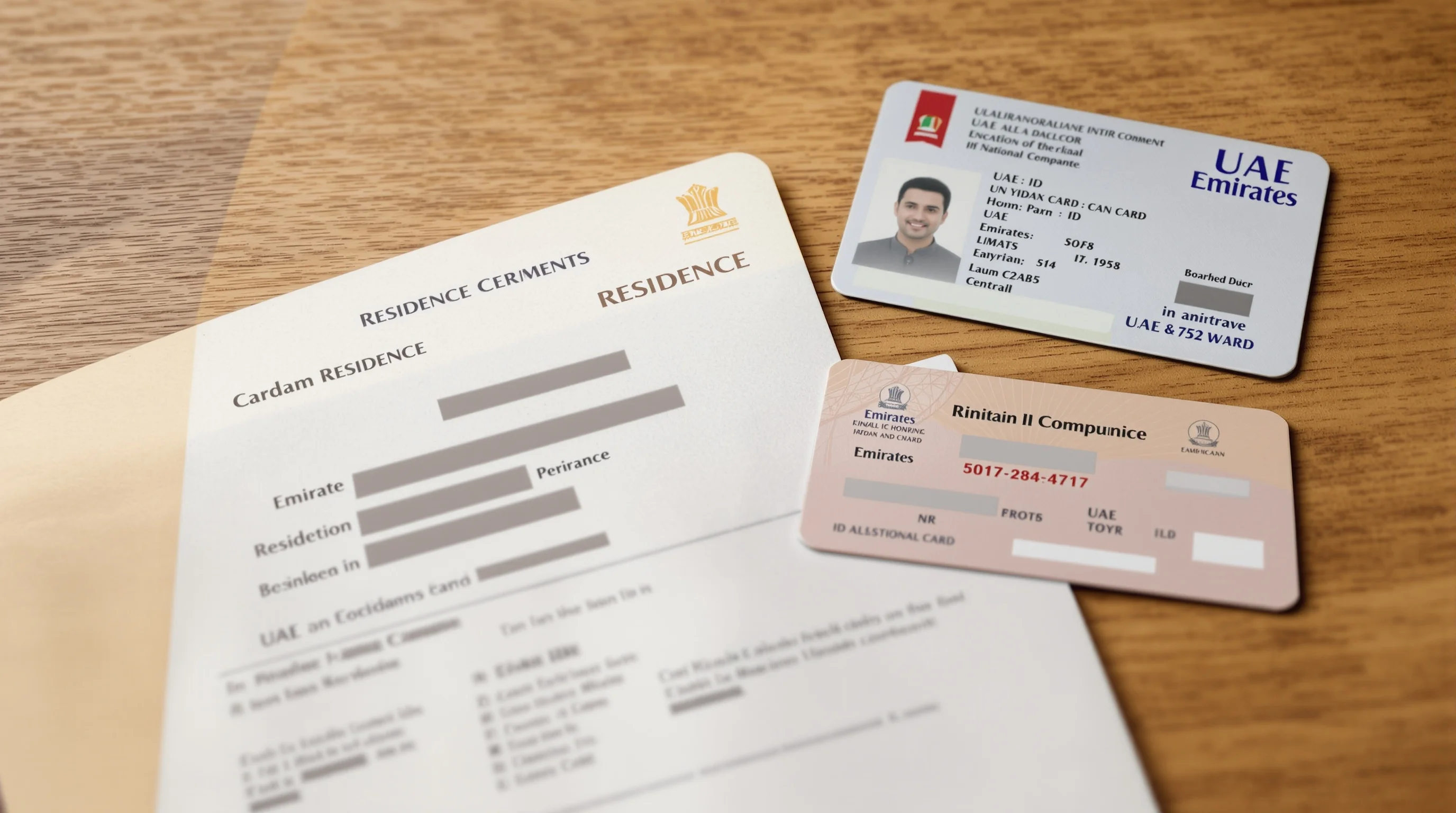
An Indian passport holder living in the UAE applies on the Emirates ID, through the Dubai or Abu Dhabi consulate, not in India.
The EUR 90 is the consulate’s charge only. VFS adds a separate service fee in dirhams. Neither charge moves with your passport. The split is set out on the fees page.
Funds provenance is the first delta. Your salary certificate and your bank statement in AED should show UAE-earned, UAE-held income. A thin net balance invites the “insufficient means of subsistence” question.
One case shows the trap. An Emirates cabin crew member, Indian, wrote on 23 June 2026. Her salary was roughly 7,000 AED. A loan to buy property in India cut it to about 5,000 AED net. She asked the Italian consulate’s likely view. The lesson is not that property hurts. The consulate reads your available balance. A loan that shrinks it needs a clear savings buffer beside it.
Home-country asset ties cut both ways. Property in India can show you have somewhere to return, or read as a pull back home. The consulate wants proof you return to the UAE. Your job and residence visa carry that, not what you own in India.
Prior Schengen history is the strongest single line in an Indian file. Thin history is the weak spot. A 24-year-old Indian national had only moved to Dubai in May 2025. She took the one open Netherlands slot and was refused on 24 June 2026.
Volume of paper does not fix this. Another Indian UAE resident filed ejari, an NOC, an offer letter, a six-month statement, and travel across 13 countries. She called it “an entire book of my existence.” She was still refused for the Netherlands on 24 June 2026. The right consulate and a clear funds story move a file. A thicker folder does not.
One warning now applies to every nationality. A consulate flagged an itinerary that “looked template like.” The applicant admitted, “yes I did use chat GPT to format it.” Consulates read AI-generated itineraries and cover letters as a visa-shopping signal. Write your own.
Prior Schengen history and the 2-year multi-entry question for Indians
A two-year Schengen visa is a rule, not a favour. The EU Visa Code sets a cascade in Article 24, in force since 2 February 2020. A consulate may issue a one-year multiple-entry visa after you use two visas lawfully in two years. A two-year visa can follow a one-year one. For an Indian first-timer from Dubai, the honest answer is no, not yet.
The cascade is the same for every passport. Indians ask about it more. Agency pages sell the 2-year multi-entry for Indians as a product. It is not a product. It is discretion. It is keyed to your used record and to the issuing consulate. Build prior Schengen history for Indian nationals first. The longer validity follows.
The processing clock is also the same for every nationality, and its two sides disagree. The Visa Code gives a consulate 15 calendar days to decide, extendable to 45 for further checks (Article 23). Dubai runs longer than the nominal. VFS and the Netherlands embassy both quoted 21 to 45 days at day 21 of a 24 April 2026 filing (reported 15 May 2026). A Czech Republic file lodged 20 April 2026 passed the two-week mark with no update (reported 4 May 2026). We print both sides with their dates rather than averaging them. The dated per-consulate table sits on the processing-time page.

The jurisdiction rule: residence, not nationality, sets where you file.
Your Indian passport does not slow this down. The season and the consulate do. Book early, and do not make non-refundable bookings against the 15-day figure.
Refusal patterns Indian UAE-residents actually hit (and what they say about the file)
The most common refusal is not about the passport. It is “insufficient proof of means of subsistence,” or an itinerary that reads as visa shopping. In our dated set, both hit strong files. One applicant had 13 countries of travel and was still refused for the Netherlands on 24 June 2026. Your strong profile is not converting into approvals. Here is the mechanism.
Three patterns repeat.
First, the wrong consulate. An Indian national in Dubai wanted to travel with a Belgian partner. Only the Netherlands slot was open, so she filed there. She was refused on 24 June 2026. Picking a country by slot, not by main destination, is the trap. The main-destination rule sits on the Schengen pillar.
Second, funds that are not clearly available. Short balance statements trigger the subsistence ground. So does a net figure thinned by a home-country loan. The fix is a UAE-held savings buffer that covers the trip. Show it across a full six months.
Third, the template itinerary. A machine-formatted plan reads as an off-the-shelf, agent-run file. Consulates penalise it. A written cover letter and a real, bookable plan carry more weight than a polished one.
There is no refusal rate for Indian applicants to print. The European Commission publishes Schengen visa statistics by consulate, not by nationality. Its 2024 data puts the UAE consulates at 23.9% refused in aggregate, against 14.8% Schengen-wide. That figure pools every nationality and profile. The easiest-country page ranks and dates those consulates. None of it isolates an Indian passport. Treat any agency number that claims to as unsourced.
Found a refusal ground or a Dubai timeline that contradicts us? Write to us at contact. We will re-check the source and publish a dated correction.
Questions people ask
Do I apply for a Schengen visa in the UAE or in India?
Can Indians get a 2-year Schengen visa from Dubai?
Which Schengen country is easiest for an Indian to get a visa from Dubai?
How long does a Schengen visa take for an Indian passport in Dubai?
We are not affiliated with any Schengen consulate, VFS Global, the EU, or the UAE Government. We quote no price of our own and we process no applications. The rules above are published government and EU figures; each applicant case is a dated community report reproduced with its source.
Sources cited only — expert review pending. For individualized advice, consult a licensed immigration professional.
Sources
Primary and official sources checked for this page:
Found a figure that's out of date, or a receipt that contradicts us?
WRITE TO US